Le Piaie
Residential and tourist settlement
- Location
- Alleghe, Italy
- Year
- 2023
- Typology
- Residential
- Status
- Ongoing
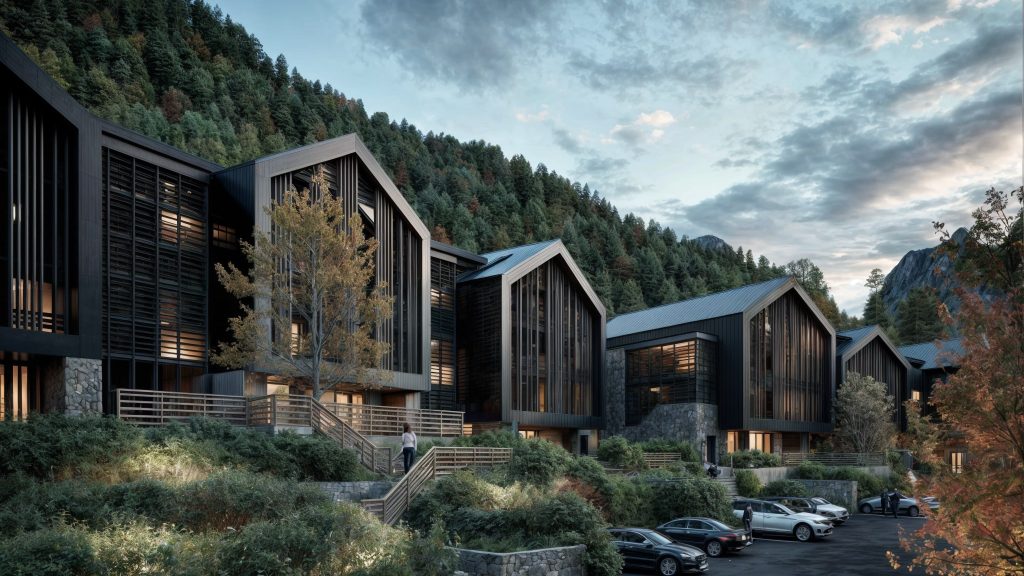
In the heart of the Dolomites, in Alleghe, this new residential complex reinterprets the traditional language of Alpine architecture in a contemporary key. This mountain “village” stands out for its varied and dynamic appearance, avoiding the repetitiveness typical of many recent developments. The project blends materials, volumes and architectural rhythms into a harmonious system, perfectly integrated into its natural setting.
All the buildings follow a pitched-roof typology and rest on a base clad in local stone, which anchors the project to the ground and recalls the solidity of old mountain buildings. The façades combine grey sheet metal, timber and dark plaster, materials chosen to balance modernity and tradition. Within this frame, a system of vertical timber screens filters the light and protects the terraces behind, evoking the structure of Alpine haylofts and giving depth to the façade.

A unified organism that keeps a strong identity without losing complexity.
Each building block is connected to the others by stair cores clad in wood and stone, elements that serve not only for circulation but also as an architectural signature of the project. The buildings follow the contour lines of the terrain, respecting its natural course and creating a complex that always appears in motion. The pitched roofs are oriented with the ridge perpendicular to the longitudinal axis of the valley floor, giving an image that is never static and a volumetric variation reminiscent of the spontaneous growth of the historic villages of the Belluno area.
The use of natural materials such as wood and stone, together with the warm tones of the plastered surfaces, allows the new architecture to merge with the Alpine landscape. The integration with the greenery and the irregular layout of the complex generate a skyline in harmony with the profile of the mountains and the woods behind.
The project works on repetition, alternation and variation, giving life to a unified organism that keeps a strong identity without losing complexity and articulation. The result is a settlement that fits into the mountain fabric with the same formal and typological richness as the historic villages of the area, showing how contemporary architecture can engage with tradition without giving up its own expressiveness.